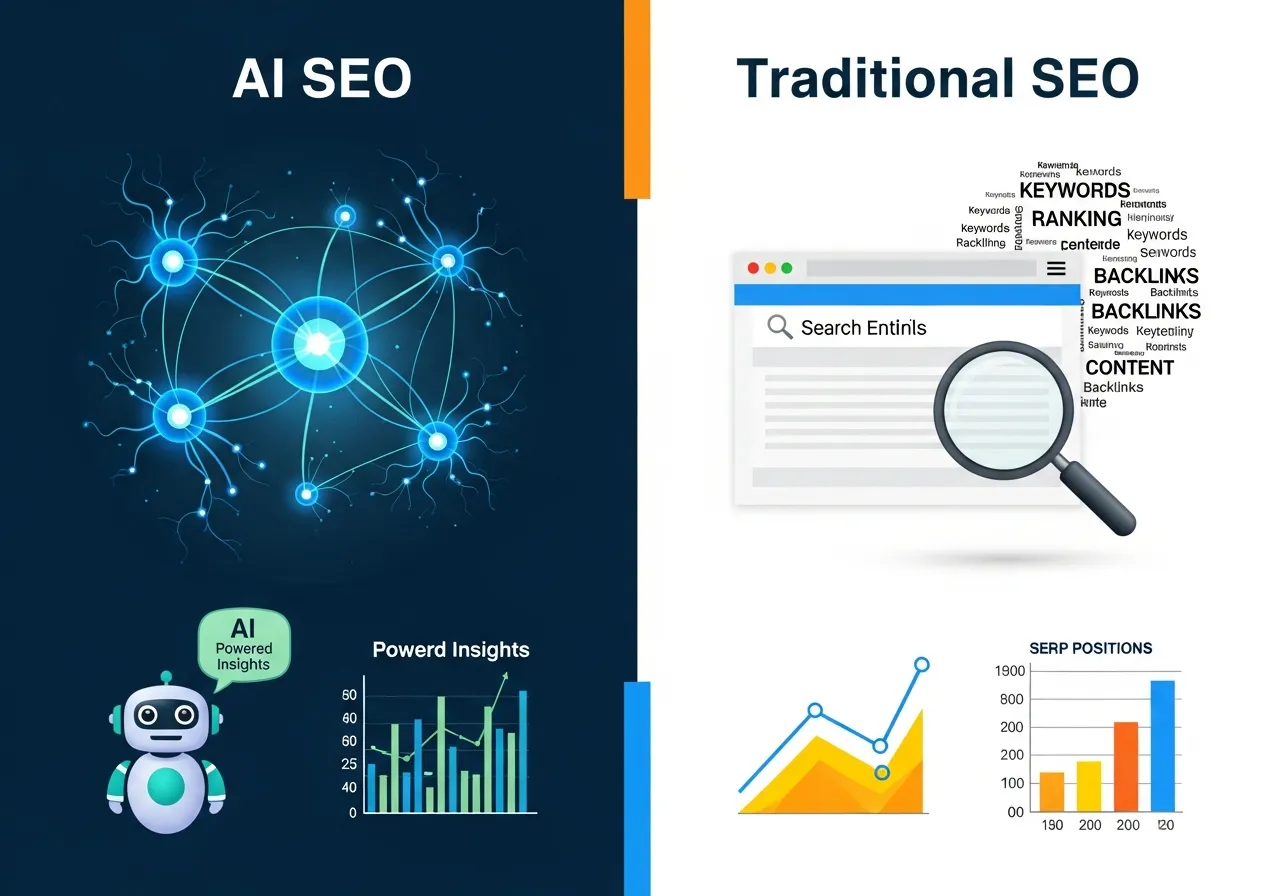
AI SEO and traditional SEO are two complementary approaches to digital visibility. To understand the fundamentals, see our guide on what is AI SEO. While traditional SEO focuses on ranking in search engine results pages, AI SEO focuses on getting cited by AI assistants like ChatGPT and Perplexity. This guide explores the key differences and explains how to succeed with both.
Understanding the Two Approaches
Traditional SEO has been the foundation of digital marketing for over two decades. It focuses on optimizing websites to rank higher in Google and other search engines, driving organic traffic through the familiar blue link format.
AI SEO (also called GEO or LLM SEO) is the newer discipline focused on getting your content cited and recommended by AI-powered search tools and language models. Instead of ranking in a list, your goal is to be the source that AI references when answering user questions.
"The best digital marketing strategy in 2026 combines both approaches. You want to rank on Google AND be cited by ChatGPT. These aren't competing goals; they're complementary."
Key Differences at a Glance
1.Success Metrics — Traditional SEO measures rankings, organic traffic, and click-through rates. AI SEO measures citations, AI referral traffic, and brand mentions in AI responses.
2.Content Format — Traditional SEO often rewards longer content that comprehensively covers keywords. AI SEO rewards clear, structured content that directly answers questions and is easy for AI to extract and summarize.
3.Keyword Strategy — Traditional SEO targets specific keyword phrases and variations. AI SEO focuses on topics, entities, and the questions users ask in natural language.
4.Authority Signals — Traditional SEO relies heavily on backlinks from other websites. AI SEO values citations from authoritative sources, expertise signals, and brand consistency across the web.
5.User Journey — Traditional SEO brings users to your website where they browse and convert. AI SEO can build brand awareness and trust even when users don't click through, as they see your brand recommended by AI.
Where Traditional SEO Still Wins
Traditional SEO remains essential for many business goals:
✓E-commerce product discovery and purchases
✓Local business searches with immediate purchase intent
✓Detailed product comparisons and reviews
✓Queries where users want to browse multiple options
✓Building consistent organic traffic over time
✓Capturing users at different stages of the buying journey
Google still processes billions of searches daily, and traditional organic traffic remains a critical channel for most businesses.
Where AI SEO Excels
AI SEO offers unique advantages for certain use cases:
✓Complex questions requiring synthesized answers
✓Research and discovery phases of B2B buying
✓Professional services where expertise matters
✓Building thought leadership and brand authority
✓Reaching users who prefer conversational search
✓Standing out in competitive niches where ranking is difficult
When an AI assistant recommends your company as the best solution, it carries significant weight with users who increasingly trust these recommendations.
Technical Optimization Differences
Traditional SEO Technical Requirements:
✓Page speed optimization
✓Mobile-friendly responsive design
✓Crawlable site architecture
✓Optimized title tags and meta descriptions
✓Quality backlink profile
✓Core Web Vitals performance
AI SEO Technical Requirements:
✓Comprehensive schema markup (JSON-LD)
✓llms.txt file for AI crawler guidance
✓Clear content structure with logical headings
✓FAQ sections with proper markup
✓Author expertise and credentials displayed
✓Consistent brand information across the web
The good news is that most technical requirements overlap. A well-optimized site for traditional SEO is already well-positioned for AI SEO with some additional enhancements.
Content Strategy Differences
Traditional SEO Content Approach:
✓Target specific keywords with optimized pages
✓Build content around search volume data
✓Create comprehensive pillar content with supporting articles
✓Focus on competitive keyword opportunities
✓Optimize for featured snippets
AI SEO Content Approach:
✓Answer questions your audience asks AI assistants
✓Demonstrate expertise with original insights and data
✓Structure content for easy AI extraction
✓Build topical authority across related subjects
✓Include citations from authoritative sources
Building a Combined Strategy
The most effective approach combines both disciplines. Here's how:
1.Shared Foundation — Start with solid technical SEO that works for both: fast, mobile-friendly sites with clear architecture and comprehensive schema markup.
2.Content That Serves Both — Create content that ranks for keywords AND answers questions clearly. Use proper heading structures, include FAQ sections, and demonstrate expertise throughout.
3.Authority Building — Build backlinks for traditional SEO while also earning citations and mentions that boost AI credibility. Focus on genuine expertise and thought leadership.
4.Measure Holistically — Track traditional metrics like rankings and organic traffic alongside AI metrics like citation frequency and AI referral traffic.
Common Mistakes to Avoid
✓Ignoring AI SEO entirely because traditional SEO still works
✓Abandoning traditional SEO to focus only on AI optimization
✓Creating content for AI that doesn't serve human readers
✓Neglecting technical fundamentals in pursuit of AI optimization
✓Treating AI SEO as a one-time project rather than ongoing strategy
Frequently Asked Questions
Q: Should I prioritize AI SEO or traditional SEO?
A: Neither should be prioritized over the other. The best strategy integrates both approaches. If you're starting fresh, begin with traditional SEO fundamentals, then layer in AI SEO optimizations.
Q: Does AI SEO require different tools than traditional SEO?
A: Many traditional SEO tools remain useful for AI SEO. However, AI SEO also benefits from manual testing of AI platforms and emerging specialized tools for tracking AI citations.
Q: Will AI SEO make traditional SEO obsolete?
A: No. While AI search is growing rapidly, traditional search engines remain dominant for many query types. Both will coexist, and smart businesses will optimize for both.
Q: How do I track AI SEO performance?
A: Monitor referral traffic from AI platforms, manually test how AI responds to queries in your niche, track brand mentions, and analyze engagement rates from AI-referred visitors.
Q: Can the same content work for both AI SEO and traditional SEO?
A: Yes. Well-structured, authoritative content that answers questions clearly works well for both. The key is ensuring your content is both keyword-optimized and structured for AI extraction.
The Bottom Line
AI SEO and traditional SEO are not competing approaches; they're complementary strategies that together provide comprehensive digital visibility. For practical next steps, learn how to implement GEO and explore the best AI SEO strategies for 2026. To understand where you stand today, consider an AI LLM SEO audit to assess your current AI visibility. The businesses that succeed in 2026 and beyond will be those that master both, ensuring they're found whether users search on Google or ask ChatGPT.
One of the biggest challenges in modern SEO is declining click-through rates. Learn proven strategies to fix zero-click search and recapture lost traffic.
Need help building an integrated AI SEO and traditional SEO strategy? See how Panovista Marketing can help with expert guidance tailored to your business goals.