B2B lead generation is built on a simple premise: be visible when potential clients are looking. For twenty years, that meant being on page one of Google and appearing in relevant industry directories. In 2026, it means something more: being cited when a potential client asks ChatGPT 'who are the leading [your category] providers in the UK?'
That query is happening millions of times a day across B2B categories. And the businesses appearing in those AI answers are getting enquiries from buyers who have already decided they're credible — before the first conversation. The businesses not appearing are being eliminated from consideration they never knew was happening.
How B2B Buyers Now Use AI Search
B2B purchase decisions are typically made by committees with long research phases. AI search has inserted itself into this process at the earliest stage — the initial landscape scan, where buyers establish the shortlist of vendors they will investigate further.
Vendor discovery. — 'Who are the leading HR software providers for mid-market companies?' or 'What are the best-reviewed management consultancies in the UK for supply chain?' These initial queries are going into ChatGPT and Perplexity — and the answers become the starting shortlist.
Capability verification. — 'Does [vendor name] work with businesses in the financial services sector?' or 'What is [agency name] known for?' Buyers use AI to rapidly verify whether shortlisted vendors meet their requirements.
Comparison research. — 'How does [vendor A] compare to [vendor B]?' AI search engines synthesise comparison information from multiple sources, providing buyers with a rapid assessment they previously spent hours compiling.
Reference checking. — 'What do clients say about working with [vendor name]?' AI models surface review data, case study content, and third-party mentions — providing a reputation summary before the buyer has visited a single website.
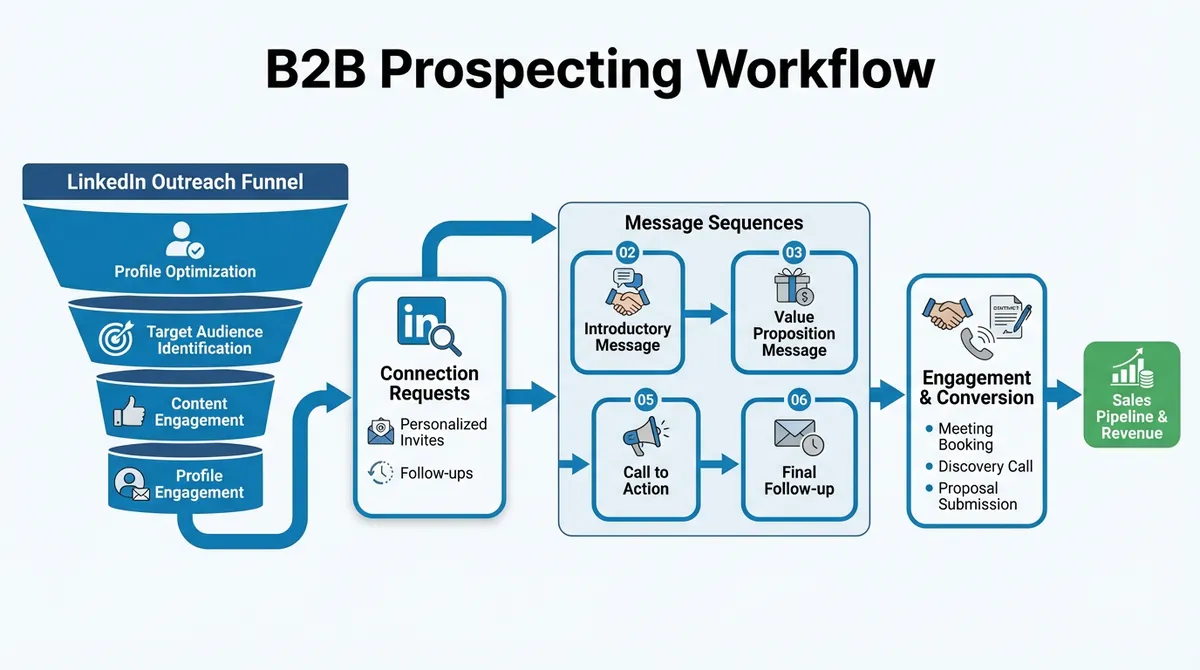
The New B2B Lead Generation Funnel
Understanding where AI search intersects the B2B funnel is essential for prioritising where to focus AI SEO investment:
✓Top of funnel — AI discovery: Buyers ask AI to identify relevant vendors. Being cited here is the new 'page one ranking'. If you are not cited, you do not make the initial shortlist.
✓Middle of funnel — AI verification: Buyers use AI to validate that vendors meet their requirements. Comprehensive, accurate, structured content about your services and client base enables positive AI verification.
✓Bottom of funnel — AI reputation check: Buyers use AI to surface what others say about working with you. Review density, case study content, and third-party editorial coverage feed this stage.
✓Post-decision — AI validation: Even after selecting a vendor, buyers often use AI to validate their decision to stakeholders. Being consistently cited with positive context supports internal buy-in.
Why B2B Companies Are Particularly Exposed
B2B companies are disproportionately affected by AI search displacement for several reasons:
Longer research phases. — The longer and more research-intensive the buying cycle, the more AI search is used — and the higher the cost of not appearing. Enterprise software, professional services, and complex B2B services are the most exposed categories.
Higher deal values. — A single missed citation that removes you from a £500,000 contract shortlist is a catastrophic invisible cost. The ROI of AI SEO investment is particularly compelling when deal values are high.
Committee buying. — Multiple stakeholders each conduct their own research. Being absent from AI search means potentially failing the individual research checks of procurement, finance, IT, and the end user simultaneously.
Lower AI SEO adoption. — Most B2B companies are not yet doing genuine AI SEO. The competitive opportunity — appearing in AI summaries before competitors — is highest in categories where adoption is still low.
Building AI Search Visibility for B2B Lead Generation
The forensic approach to B2B AI SEO lead generation has three core components, developed by Ian Ayliffe (First-Class Honours in Computer Forensics & Security from Leeds Beckett, Guest Lecturer at Imperial College London):
Category authority building. — Your business needs to be a recognised entity in the AI model's understanding of your service category. This requires consistent entity signals, comprehensive service schema, and third-party citation in sources AI models treat as authoritative for your sector.
Capability content architecture. — Content that directly answers the questions buyers ask during vendor research — service scope, client fit, delivery approach, team credentials — structured for AI extractability. This is distinct from traditional 'about us' content and requires forensic structural analysis.
Reputation signal amplification. — Case studies, testimonials, award listings, directory placements, and editorial coverage that AI models can surface in response to reputation queries. Each of these sources needs to be structured for AI discoverability, not just human readability.
💡 Tip:Ask ChatGPT right now: 'Who are the leading [your service category] companies in [your geography]?' If your company is not in the answer, you have a measurable AI visibility gap. Write down the companies that do appear — then examine what content, schema, and third-party citations they have that you currently lack. This competitive gap analysis will show you your specific AI SEO priorities.
Measuring AI Search Impact on Lead Generation
Measuring the impact of AI SEO on lead generation requires new metrics alongside traditional ones. The Panovista AI Visibility Audit establishes a baseline and tracking framework for:
✓Citation frequency — how often your business is cited across ChatGPT, Perplexity, and Microsoft Copilot for target vendor-selection queries
✓Citation accuracy — whether AI responses about your business accurately represent your services, positioning, and strengths
✓Competitor citation gap — how your citation frequency compares to competitors across the same query set
✓Branded search uplift — increases in branded search volume that indicate AI-driven discovery is generating name recognition and direct search behaviour
Frequently Asked Questions
Q: Is AI search more important than LinkedIn for B2B lead generation?
A: They serve different roles. LinkedIn is primarily an outbound and relationship channel. AI search is an inbound discovery channel — it captures buyers at the moment they are actively researching vendors. The two are complementary: AI search visibility generates the first consideration, LinkedIn activity and [LinkedIn lead generation](/blog/linkedin-leads-generation) convert consideration into contact.
Q: How quickly can AI SEO improve our inbound enquiry volume?
A: Quick technical fixes — unblocking AI crawlers, deploying schema, implementing llms.txt — can show citation improvement within 2-4 weeks. Building consistent category authority for competitive vendor-selection queries typically takes 3-6 months. The impact on inbound enquiry volume follows citation improvement with a lag of 4-8 weeks, as buyer research cycles complete.
Q: Should we invest in AI SEO before or after fixing our traditional SEO?
A: For most B2B companies, concurrently. Much of the technical work — schema markup, content structure, AI crawler access — benefits both AI citation and Google rankings. And the AI SEO opportunity is currently less competitive than Google in most B2B categories, meaning faster initial results. See our [AI SEO vs traditional SEO guide](/blog/ai-seo-vs-traditional-seo) for a full comparison.
Q: How do we know which AI search queries our buyers are actually using?
A: Through systematic query research — the same process we run in every [AI Visibility Audit](/services/ai-seo-audit). We map the vendor-selection, capability-verification, and comparison queries specific to your category and geography, then test them across all major AI platforms to establish your current citation position and the gap to your most AI-visible competitors.
Is your business appearing when B2B buyers ask ChatGPT or Perplexity to recommend vendors in your category? Book a discovery call with Ian to find out exactly where you stand — and what a targeted AI SEO programme would do for your inbound lead pipeline.