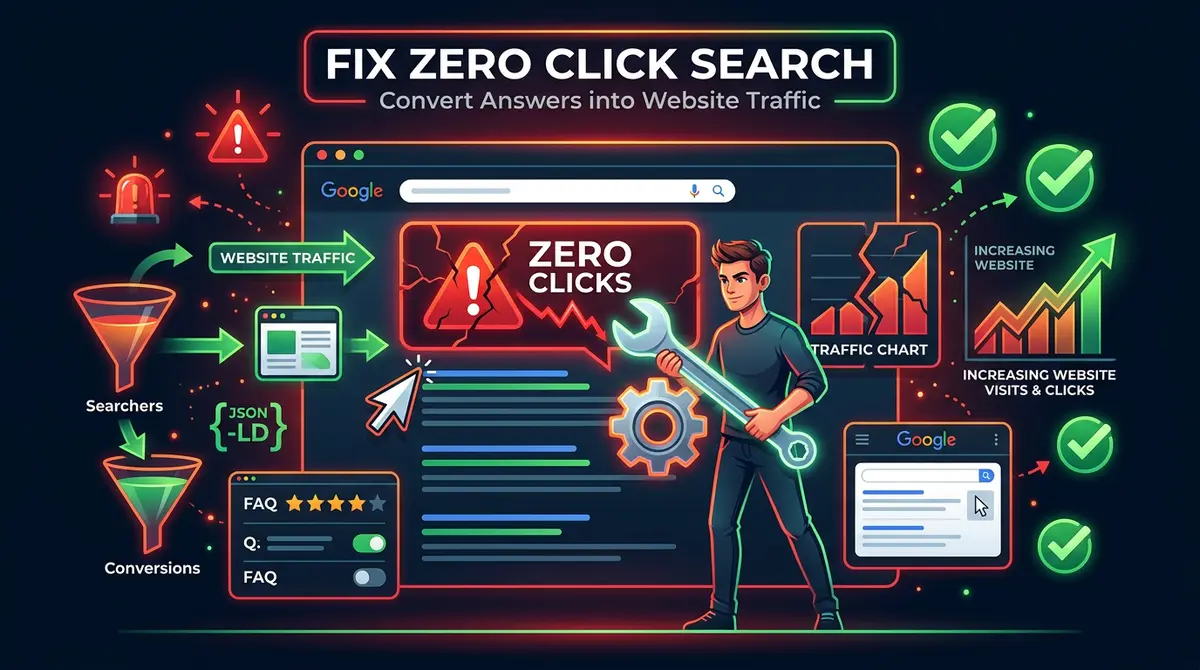
Your organic traffic is not leaking — it is being intercepted. Every time a potential customer asks ChatGPT which agency to use, searches Google and gets an AI Overview, or queries Perplexity for a product recommendation, there is a moment where they either see your business or they do not. If they do not, they may never reach your website. This guide is the forensic playbook for fighting back — built on the same principles that have helped Panovista clients establish AI search visibility in the most competitive categories.
Understanding the Interception Problem
Traditional SEO was a fair fight: your page versus your competitor's page, ranked by Google, clicked by users. AI search changes the rules. Now there is an intermediary — an AI model that reads your content, synthesises it with other sources, and answers the user directly. The user may never see your site.
This is not universally bad. If the AI cites your business as the answer, you receive a brand mention that carries more implicit authority than a blue link. But if it cites your competitor instead, you have lost the visit AND the trust signal. Understanding AI SEO vs traditional SEO is the starting point for any fight-back strategy.
The 4-Part Forensic Fight-Back Strategy
1.Become the Source — The most powerful position in AI search is being the source the AI draws from. When ChatGPT answers a question about your industry and cites your content, it endorses you to millions of users. Our [forensic primary source methodology](/blog/forensic-secret-primary-source-llms) builds the technical and content signals that make your site the preferred source for AI models.
2.Own the Brand Query — Even when AI answers intercept informational queries, users who have seen your brand mentioned will search for you directly. Branded search traffic bypasses AI interception entirely. Build awareness through AI citation so that branded navigational queries replace the lost informational traffic.
3.Target Queries AI Cannot Fully Answer — Complex, multi-step, highly specific, or locally nuanced queries are harder for AI to answer completely. These are your highest-click opportunities. A forensic [keyword strategy](/blog/best-ai-seo-strategies-2026) identifies which queries in your category still reliably drive clicks.
4.Convert at Higher Rates — If fewer people reach your site, each visit must work harder. With AI-intercepted traffic declining, conversion rate optimisation becomes as important as traffic acquisition. Every visitor who does arrive should be met with a clear, compelling path to contact or purchase.
The First-Mover Advantage
Here is the uncomfortable truth: AI search authority compounds. The businesses that establish entity recognition, content citation, and structured data now will be the ones AI models consistently recommend in 12, 24, and 36 months. Late movers face not just a technical gap but an authority gap that is significantly harder to close.
Ian Ayliffe (First-Class Honours in Computer Forensics & Security from Leeds Beckett, Guest Lecturer at Imperial College London) has been building AI search authority for clients since before most agencies acknowledged the channel existed. The forensic advantage is real — and it is available to businesses that move now.
✓Audit your robots.txt to ensure GPTBot, PerplexityBot, and ClaudeBot are not blocked
✓Deploy a comprehensive llms.txt file that guides AI crawlers to your authoritative content
✓Implement Organisation, Service, and FAQ schema across your key pages
✓Restructure your top content pages for question-answer extractability
✓Build third-party citations through industry publications, directories, and press mentions
✓Track AI citations weekly across ChatGPT, Perplexity, Claude, and Google AI Overviews
What the Fight-Back Looks Like in Practice
Our AI Risk Calculator gives you an instant read on your current AI visibility risk. It takes 60 seconds and tells you exactly which of the interception problems your business faces. From there, our AI Visibility Audit provides the forensic depth — a 30-page report covering your full AI search presence, competitor citation mapping, and a prioritised roadmap.
💡 Tip:Run this experiment monthly: ask ChatGPT, Perplexity, and Claude the same 10 questions your best customers would ask. Track which of those queries mention your business. The trend line — improving or worsening — tells you whether your fight-back strategy is working.
Frequently Asked Questions
Q: Is it worth fighting AI search or should I just accept the traffic loss?
A: Fighting back — by becoming the cited source rather than the bypassed website — is far more valuable than accepting the loss. Businesses cited in AI responses gain brand authority that compounds. Those that accept the loss fall progressively further behind.
Q: How much traffic can I realistically recover?
A: You will not recover the zero-click traffic — those queries will not start clicking again. But AI citation generates new brand-aware traffic through direct search, and businesses with strong AI visibility see overall lead volume hold or grow despite falling traditional organic traffic.
Q: Does this work for small businesses?
A: Yes — and small businesses often have an advantage. Niche expertise, local authority, and specialist knowledge are exactly what AI models look for. Our [AI local SEO guide](/blog/ai-local-seo-guide) covers the specific approach for local businesses.
Ready to fight back against AI search interception? Book a free strategy call with Ian and get a forensic assessment of your AI visibility within 48 hours.