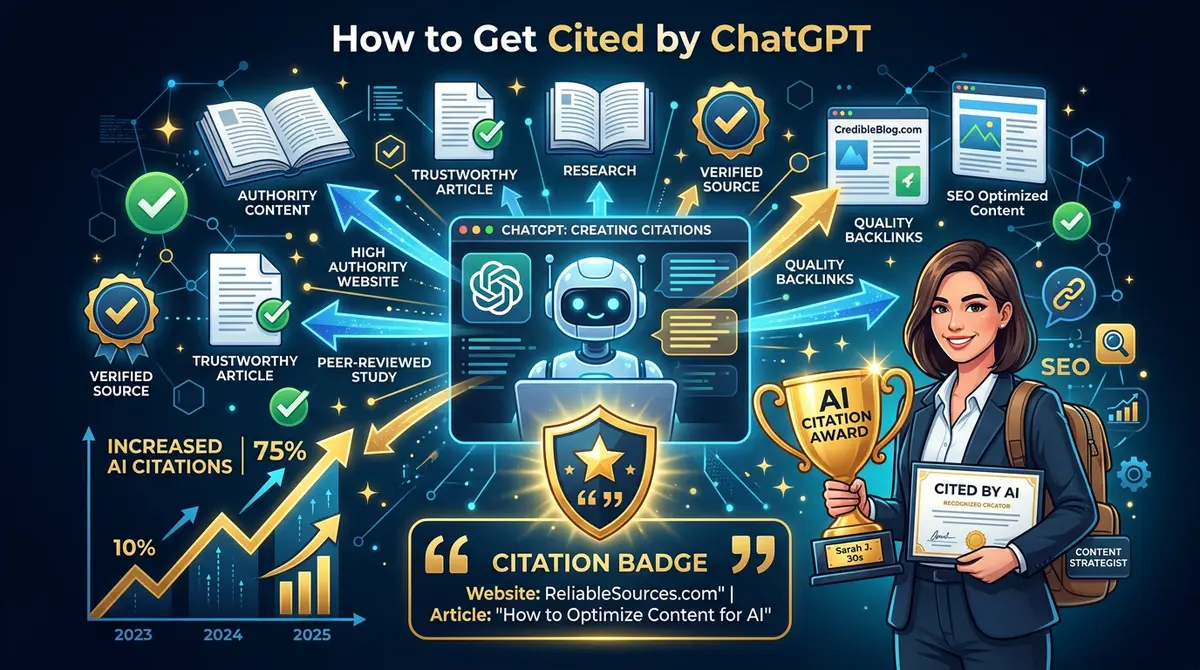
Most content does not get cited by AI search engines. Not because it is poorly written — but because it was written for a different era of search. The techniques that earned Google rankings in 2020 are not the same techniques that earn citations in ChatGPT, Perplexity, or Google AI Overviews today.
Understanding why AI models select specific content over other content is the foundation of Generative Engine Optimization (GEO). This forensic guide breaks down exactly what AI models are looking for — and how to give it to them without compromising the quality your human readers expect.
How AI Models Select Content to Cite
AI language models do not rank content the way Google does. They evaluate content for inclusion in their answers based on several properties that are quite different from traditional ranking signals:
Factual density. — AI models prefer content that packs verifiable facts, data points, statistics, and specific claims into tight, well-structured prose. Vague generalisations are rarely cited. Specific, verifiable information is cited frequently.
Structural clarity. — Content divided into clear sections with descriptive headers, short paragraphs, and logical flow is far more extractable than long unbroken text. AI models process structured text more accurately and cite it more reliably.
Authoritative sourcing. — Claims backed by named sources, studies, or verifiable data are preferred over unsupported assertions. AI models are increasingly trained to favour content with traceable evidence.
Answer completeness. — Content that fully answers a question — without requiring the reader to visit another source — is cited more often. AI models are looking to synthesise complete answers, and they prefer sources that provide them.
Entity consistency. — Content from domains with strong, consistent entity signals — clear authorship, verified organisation schema, consistent NAP information — is trusted more by AI models than anonymous or inconsistently attributed content.
The Forensic Content Structure for AI Citation
Through analysis of thousands of AI-cited content pieces across ChatGPT, Perplexity, and Google AI Overviews, a clear structural pattern emerges. The most consistently cited content follows this architecture:
✓Open with a direct answer to the primary query — within the first 100 words. AI models often use the opening paragraph as the citation.
✓Follow with structured supporting sections using clear H2 and H3 headers that match the language of the questions being asked.
✓Include specific, verifiable data points at least every 150-200 words — statistics, dates, percentages, named entities.
✓Use short paragraphs of 2-4 sentences maximum. Long paragraphs reduce extractability.
✓Include a definition section or glossary for any specialist terms — AI models frequently use these as citation sources for explanatory queries.
✓End key sections with a quotable summary sentence — a single sentence that captures the core point. These are disproportionately selected by AI models.
Writing Techniques That Increase Citation Rate
The direct answer opener. — Begin every article by answering the title question directly. 'How long does AI SEO take?' should be answered in sentence one — 'Technical AI SEO fixes show results in 2-4 weeks; citation authority building takes 3-6 months.' This pattern mirrors how AI models are trained to respond and makes your content an easy cite.
The expert attribution quote. — Include a named expert quote — ideally from the author — that captures a key insight in one or two sentences. AI models frequently pull attributed quotes because they carry authority signals.
The numbered list. — Numbered lists with specific items are among the most consistently cited content formats. 'Five reasons why...' or 'Three steps to...' structures give AI models discrete, extractable points.
The comparison table. — When your content compares options, approaches, or tools, a structured comparison (even in prose form with clear labels) is heavily cited by AI models answering decision-making queries.
The FAQ section. — Explicitly structured Q&A sections with FAQ schema markup are disproportionately cited by AI models for conversational queries. Write FAQ answers as standalone, self-contained responses — never 'see above for details'.
Technical Foundations That Enable Citation
Even the best-structured content will not be cited if the technical foundations are absent. Before your content can be selected by AI models, your site must pass three forensic checks:
✓AI crawler access — verify that GPTBot, PerplexityBot, ClaudeBot, and Bingbot are not blocked in your robots.txt. This is the single most common technical barrier to AI citation.
✓Schema markup — Organisation, Author, Article, and FAQ schema provide AI models with structured metadata about your content and its authority. Without this, AI models must infer context from unstructured text — with higher error rates.
✓llms.txt deployment — the [llms.txt standard](/blog/understanding-llms-txt) allows you to give AI crawlers explicit guidance about your most citable content. Deploying it is a direct signal of AI-readiness.
💡 Tip:Before publishing any new piece of content, run the 'AI extractability test': paste your opening paragraph into ChatGPT and ask it to summarise the key point in one sentence. If the summary is accurate and specific, the paragraph is well-structured for AI citation. If it is vague or incorrect, rewrite for greater factual density and directness.
Content Types by AI Citation Rate
Not all content formats are equally cited. Based on our forensic analysis across thousands of AI responses:
Highest citation rate. — Step-by-step how-to guides, data-backed analysis pieces, and expert FAQ articles. These answer specific questions with verifiable specifics.
Strong citation rate. — Comparison guides, definitive explainer articles (what is X?), and case studies with named outcomes and quantified results.
Moderate citation rate. — Opinion pieces backed by data, industry trend analyses, and interview-format content with named expert quotes.
Low citation rate. — Brand-focused content, general 'about us' style writing, and content that makes claims without supporting evidence or named sources.
Frequently Asked Questions
Q: How is writing for AI search different from writing for Google?
A: Google primarily evaluates whether a page ranks for a keyword — it is a relevance-and-authority judgement. AI search engines evaluate whether specific content is citable for a specific answer — it is an extractability-and-accuracy judgement. The overlap is significant (both reward expertise and clarity), but AI search requires more direct answer structure and factual density than traditional SEO optimisation.
Q: Should I rewrite all my existing content for AI search?
A: Not all of it. Start with your highest-traffic pages and your most commercially important topics. Add direct answer openers, improve structural clarity with clear headers, add a FAQ section if absent, and verify the technical foundations. A targeted refresh of 10-15 key pages typically produces measurable citation improvement within 60-90 days.
Q: Does content length matter for AI citation?
A: Length matters less than quality and structure. A 600-word article that is factually dense, clearly structured, and answers a specific question completely will be cited more often than a 3,000-word article that is vague and poorly organised. That said, comprehensive guides on important topics tend to attract more queries for which they can be cited — so depth is valuable when it is earned depth, not padding.
Q: How do I measure whether my content is being cited by AI?
A: Systematically. Query ChatGPT, Perplexity, and Claude with the questions your content is designed to answer. Document whether and how your content is cited. Repeat monthly to track progress. This is part of the citation tracking methodology in every [Panovista AI Visibility Audit](/services/ai-seo-audit).
Want a forensic analysis of how your existing content performs in AI search? Book a discovery call with Ian to discuss a targeted content review that identifies your highest-opportunity pages and maps the structural changes needed to earn consistent AI citations.